He Accuses Hovik Abrahamyan

In an interview with our reporter yesterday, Grisha Virabyan of Artashat, who has received political asylum in Belgium, made a sensational announcement: “While he was Deputy Prime Minister, Hovik Abrahamyan took 3 million dollars from one of the current ruling government members to give Robert Kocharyan, saying that he was following Kocharyan’s instructions, but gave only 1 million dollars to Kocharyan,” said Virabyan. Yesterday when we asked for confirmation or denial of this new information, Head of the NA Public Relations and Media Department Gohar Poghosyan stated, “It is just more of Grisha Virabyan’s nonsense and lies.”

In the interview with our reporter, Grisha Virabyan said, “If Hovik Abrahamyan or Robert Kocharyan deny that information in the press, I am ready to name definite people and reveal when it happened and most importantly, what outcome it had.” In response to our question of whether he understood that he was accusing people of having committed a crime, and that could be considered slander or false testimony, Grisha Virabyan answered, “I have stated many times that any activity of Hovik Abrahamyan is a crime and he, by having taken that position, endangers the national security of the country. I do not have the authority of a prosecutor or an investigator; I am saying that it is the authorities that should prove it. I can name the sphere, and the minister from whom they took the money. There are recorded facts.” Grisha Virabyan has not yet provided any further information.

Between Process and Event

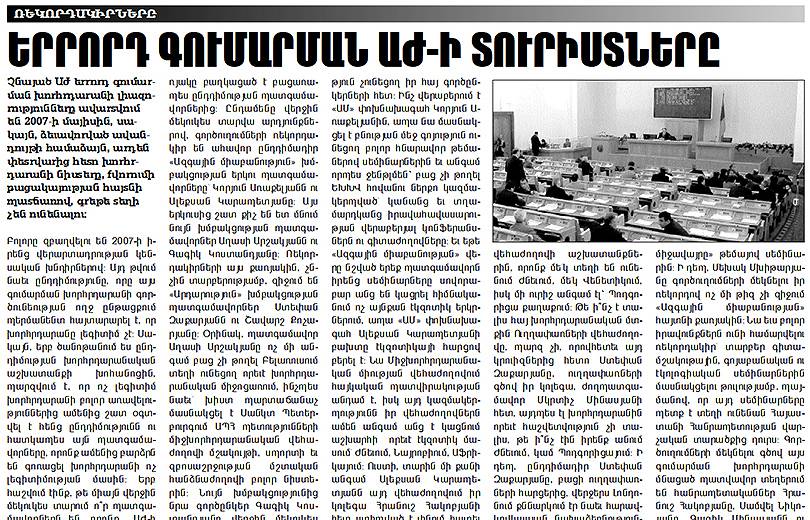
Armenia’s traditional, socio-political thinking sometimes shocks me in its brevity. In many cases, brevity should be understood in its literal sense. Either because well-known figures, while interpreting developments are often unable to look ahead or back from, a given point, or the radii of these types of interpretations is unbelievably short, almost to the point of non-existence. This fact became obvious again following the recent statement made by Medvedev-Obama-Sarkozy. Known and unknown circles again and again accused the Armenian National Congress of presenting the negotiation process of the Karabakh conflict in а pessimistic light and raising alarms about the possible (disproportionate) return of the liberated territories, especially since these territories remain under the control of Armenia’s armed forces, as they were before.

It is in these types of interpretations that the shortness of Armenian traditional, socio-political thinking lays. It is not able to understand processes, its comprehension of developments is often delayed, it is not capable of noticing changes in a given situation that, albeit insignificant at the moment, become significant in time, even transformative. For instance, being familiar with a person’s psychological makeup, you insist that he is going to commit suicide. You can’t prove it. And all those who consider your assertion to be inane think so based on the argument that the man whom you deem suicidal is alive. Then you hear that the man is going up to the roof of his multistory building. You analyze the situation you insist that he is about to jump off the building. But you still can’t prove it, because those who deny your suicide version have an argument—the man is still alive. There may even be someone who will insist that the man is going up to find a location for his new TV set and antenna. He might really meet some people who are placing antennas or doing something else on the roof, and go back down with them. At that point they will really laugh at your suicide theory. And they would be “right” because they would have an argument—the argument that the man is alive—while you can’t prove that psychologically and morally he has said farewell to his life long ago. And when the potential suicide realizes that a great deal of interest is focused on him, he will go up to the roof at night and throw himself down without anyone’s knowledge. Up until the moment when he throws himself down, all those who did not want to believe in your assumption would be right, but from the moment when he jumps to the moment of his death you would be right. As a result, you would be right but only for a few seconds, because those who did not believe your assumption would have been right for hours, days, months and maybe years.

Going back to the issue of Karabakh, I cannot but notice that some literate Armenians treat the situation in a similar way—some because of self-interest, others with no self-interest. Sometimes I think that this technical problem in reality has a genetic origin. We, Armenians, do not hurry to see a doctor when we feel pain in some part of our body but we rely on the fact that the pain just keeps recurring and doesn’t last that long. Meaning that we are alive, we don’t feel bad in general and we can eat, drink, rejoice and have fun. As for the pains, well, everybody has pains and there is nothing strange in that. The logical extension here is that the average Armenian sees the doctor only when the pain has deprived him of the ability to eat, drink, hear and perceive. Meaning that there’s nothing left to do but order a coffin. It seems that many people want to disseminate this type of perception of the Karabakh conflict in the consciousness of the Armenian public; or, at the very least they themselves grasp the situation along those lines, starting with the statement made by the presidential trio and ending up with numerous documents approved by PACE, UNO and the European Parliament. Those who perceive the situation in this way are right for the moment; they were right yesterday; and they may be right tomorrow, or for a long time to come. But they will be wrong for a split-second and it is in that split-second that everything will be decided.

Notification

In Three Days

The next issue of the “Haykakan Zhamanak” daily will be released on Tuesday, July 6.

Կոչ «Հայկական ժամանակ»-ից


Նիկոլ Փաշինյանի անձնական էջ